

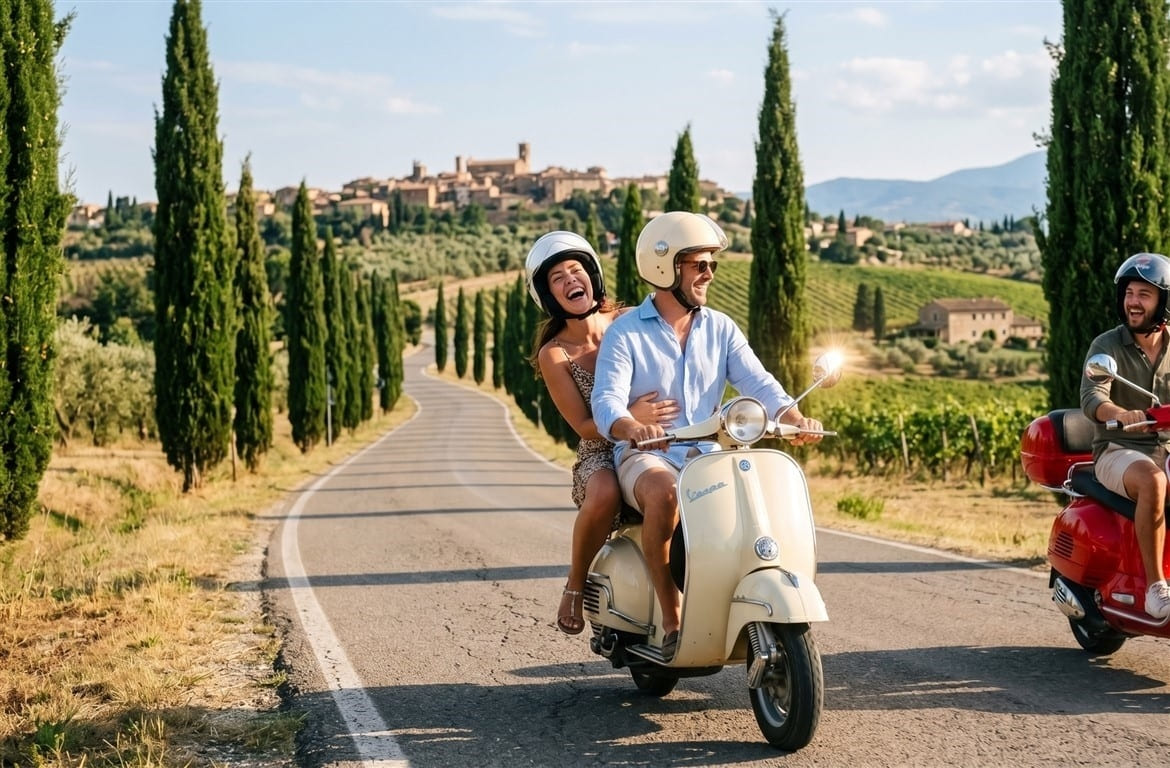

Vespas in Italy: Scooting Through Italy in 2026
Italy, seen from the seat of a Vespa, sounds almost ridiculously perfect. It’s like a postcard decided to get up and move. You know the image: a creamy scooter, a cypress-lined road, sun dancing on the mirror, maybe the distant echo of laughter after a long meal. Totally. That cliché? It’s popular because folks keep chasing it, and here’s the kicker – it often works.
Riding a Vespa in Italy come 2026 isn’t just about the romantic daydreams. There’s real travel involved. Think transportation logistics, unpredictable weather, the mountain of paperwork, how locals actually drive, those hefty rental deposits, helmets that absolutely *destroy* your hair, and the sheer joy of snagging a parking spot a car would never find. Do it right, and a scooter trip transforms places like Tuscany, the Amalfi Coast, Puglia, Sardinia, Veneto, and Chianti into intensely personal experiences. You’ll catch the scent of freshly cut grass near a vineyard. You’ll hear church bells chiming long before you actually see the village. You’ll pull over, just because the road twists and the view suddenly gets audacious.
Why Vespas Just *Belong* in Italy
The Vespa Story: A Brief History
The Vespa came roaring to life in post-war Italy. Piaggio desperately needed a new direction, and the country cried out for cheap, practical ways to get around. So, in 1946, the very first Vespa rolled out, courtesy of aeronautical engineer Corradino D’Ascanio. Enrico Piaggio, the legend, reportedly named the scooter “Vespa” because its shape and sound reminded him of a wasp. And yes, “Vespa” means “wasp” in Italian. A small fact, but oh, what a huge mythology it spawned!
That design? It was brilliant. A step-through frame meant anyone could ride it in their everyday clothes. The engine, neatly tucked away, kept grease off pants and skirts. A front shield offered a little splash protection. Compared to the bulky motorcycles of that era, the Vespa felt clean, sophisticated, and utterly charming. Not a brute beast, this one. More like a clever, zippy city creature.
By the 1950s and ’60s, Vespas had weaved themselves into Italian cinema, into daily commutes, into the very essence of teenage freedom, becoming an undeniable symbol of *la dolce vita*. Rome itself, without even trying, did most of the advertising. One classic black-and-white movie, a stylish woman perched on the back, a scene near the Spanish Steps – and just like that, the machine became pure emotional gold. You don’t need to be steeped in nostalgia to feel it. That iconic silhouette still does its magic.
Why Scooters Fit Italy Like a Glove
Italian towns? They were certainly not built with rental SUVs in mind. Loads of historic centers boast narrow, winding lanes, cobblestone streets that are anything but even, blink-and-you’ll-miss-it sightlines, scarce parking, and those infamous restricted traffic zones, the ZTL areas. A scooter, though, feels completely at home here. It takes up barely any space, sips fuel compared to a car, and effortlessly glides between ancient hill towns without turning every single stop into a full-blown logistical debate.
There’s a certain social rhythm that scooters just tap into. You can leave right after breakfast, zip to a local market, detour to a hidden beach, pause at a bar for a quick espresso, then slowly climb back towards your agriturismo before dinner. No big fuss. No trunk packed to the brim. Just a jacket, your phone mounted for navigation, maybe a crumpled paper map if you’re old-school, and enough humility to pull over immediately when a local driver appears behind you, revving with the patience of a very annoyed hornet.
The Best Spots for a Vespa Adventure in Italy
Tuscany
Wine Roads, Charming Hill Towns, and Endless Countryside Views
Tuscany? That’s the quintessential Vespa region. Seriously, those roads look like they were custom-designed for leisurely travel. You’ll find rolling hills, gravel farm tracks (definitely don’t take those unless your rental contract gives you the green light), sprawling vineyards, ancient olive groves, and villages perched on ridges like a polite painter carefully placed them there.
Fantastic home bases include Florence for structured day trips, Siena for exploring the southern loops, San Gimignano for those unforgettable medieval skylines, and the Val d’Orcia for all the dreamier stretches near Pienza, Montalcino, and Bagno Vignoni. The only real snag? Some of those rural roads are pretty tight, and yes, tour buses *do* materialize near popular viewpoints. Early mornings feel utterly pristine. Late afternoons absolutely glow. But try midday in July? You might just feel like you’re riding inside a pizza oven.
Amalfi Coast
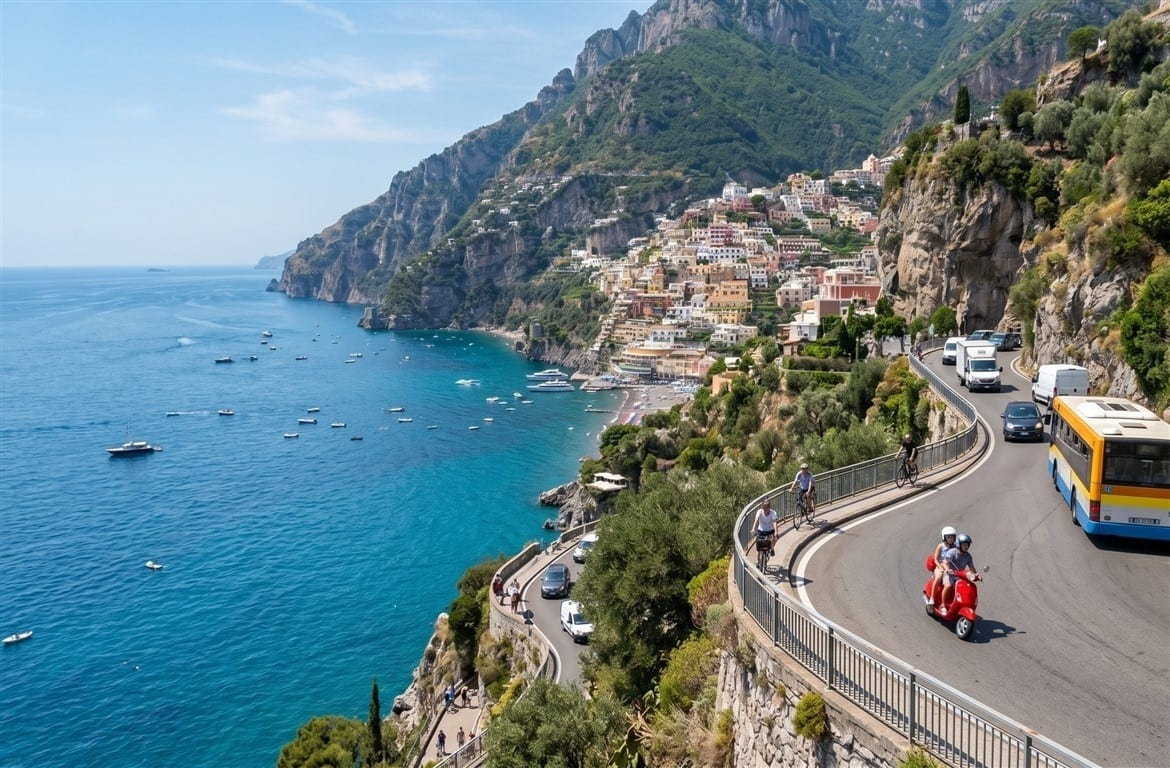
Stunning Coastal Roads and Breathtaking Sea Panoramas
The Amalfi Coast is jaw-droppingly dramatic, utterly gorgeous, and completely unforgiving. The SS163 road snakes along sheer cliffs, connecting Positano, Amalfi, Ravello, Minori, Maiori, and Vietri sul Mare. A scooter can certainly help you beat the horrendous traffic and parking nightmares, but be warned: this same road also carries buses, delivery vans, taxis, pedestrians, cyclists, and plenty of travelers who gaze at the mesmerizing sea instead of the actual lane. That’s not a poetic observation; it’s a genuine risk factor.
Experienced riders typically find more joy on the Amalfi Coast than beginners. If your last scooter ride was a chill island holiday a decade ago, seriously consider a guided tour or stick to off-peak hours. Sorrento makes a decent rental base, but parking in Positano is cramped and priced with audacious confidence. Ravello is absolutely worth the climb. And those views near Conca dei Marini and Furore? They can hush even the most jaded traveler for a solid minute.
Puglia
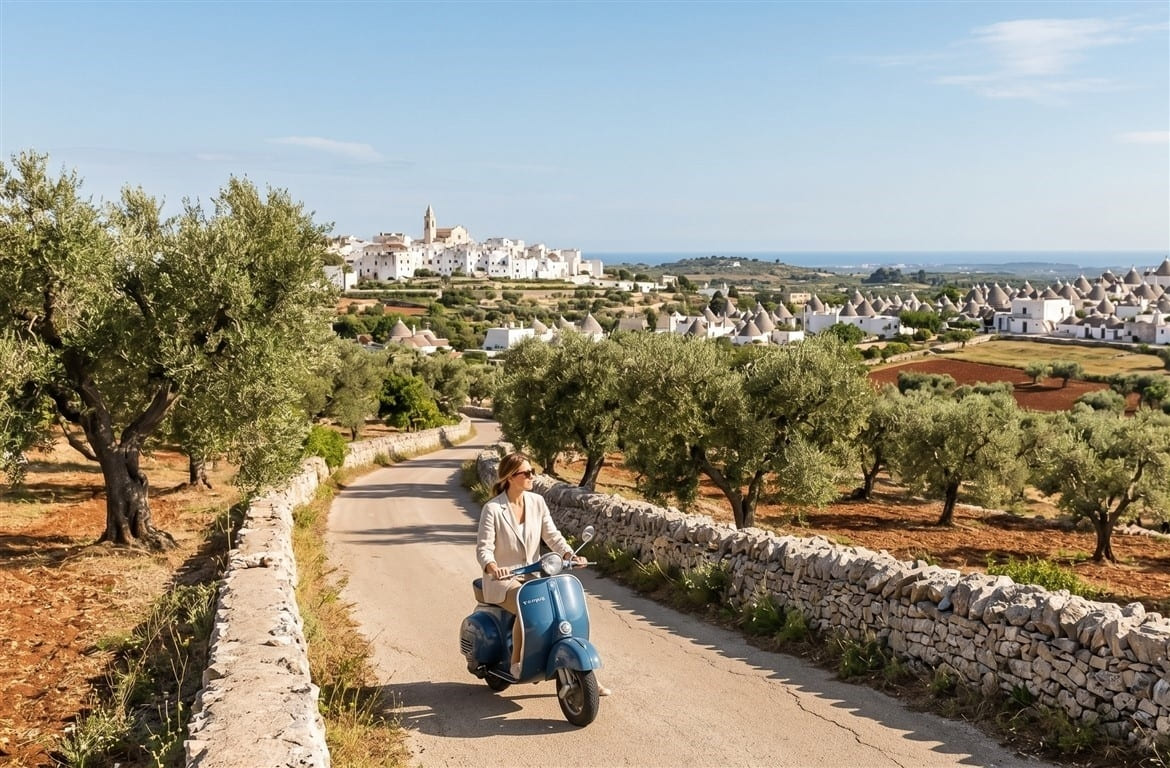
Sun-Kissed Beaches, Whitewashed Villages, and Laid-Back Southern Charm
Puglia offers a whole different vibe. It’s flatter in places, sunnier in spirit, and full of routes where a scooter feels effortlessly natural, not like a showy performance. The Valle d’Itria is just perfect for riding between Alberobello, Locorotondo, Cisternino, and Martina Franca. Think whitewashed towns, those unique *trulli* roofs, ancient dry-stone walls, and olive trees that look older than recorded history.
Along the coast, places like Polignano a Mare, Monopoli, Ostuni, Otranto, and Gallipoli all draw summer crowds. A Vespa truly shines here for quick hops, beach stops, and finding a spot in town. The main adversary from late June through August is the heat. Finding shade becomes less about comfort and more about survival strategy.
Sardinia
Epic Coastal Routes and Wild, Untamed Landscapes
Sardinia is far bigger than many first-time visitors expect. For quick jaunts from your resort to the beach, a scooter is pure bliss. But if you’re planning to cross half the island, you’ll definitely want something more substantial than a tiny city scooter, or simply rent a car. The coastal roads near Costa Smeralda, Alghero, Bosa, Villasimius, and the Gulf of Orosei are just stunning. Expect brilliant blue water and rugged hills that, in warm air, smell intensely of myrtle.
The road from Alghero to Bosa is a firm favorite for many riders: endless sea views, sweeping open curves, and plenty of space to just breathe. Don’t rush it. Goats, random patches of sand on bends, sudden gusts of wind, and wandering tourists are all part of the scenery. Whether you invited them or not.
Veneto
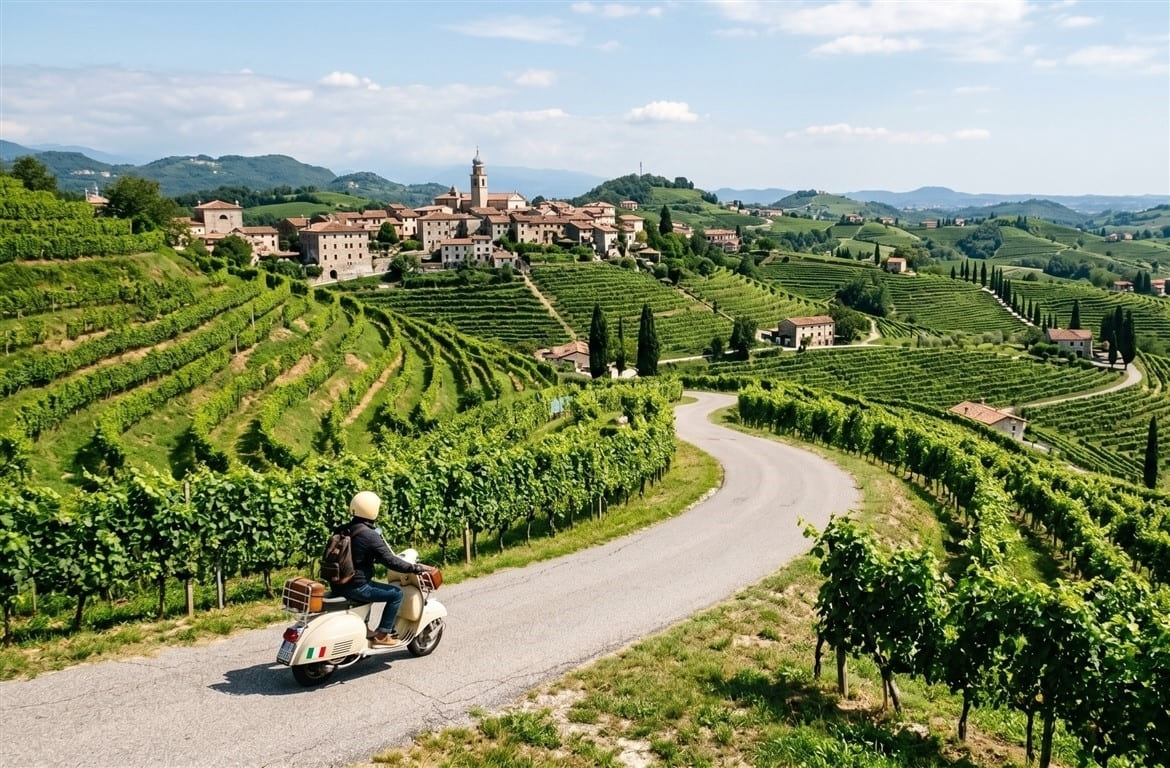
The Gentle Prosecco Hills and Historic, Elegant Towns
Veneto offers so much more to scooter travelers than just Venice. (In fact, Venice itself is definitely *not* scooter country within the lagoon city.) Look inland instead. The Prosecco Hills around Valdobbiadene and Conegliano are absolutely beautiful by Vespa, with winding vineyard roads, charming small *osterie*, and viewpoints that feel far calmer than the more famous regions.
Vicenza, Bassano del Grappa, Asolo, and the Brenta Riviera make excellent anchor points for rides steeped in grand architecture, picturesque river towns, elegant villas, and cafés where no one seems to be in a hurry—until they get behind the wheel, that is. Just keep an eye on the weather when you’re near the foothills. A perfectly sunny morning can turn surprisingly moody in a flash.
Chianti
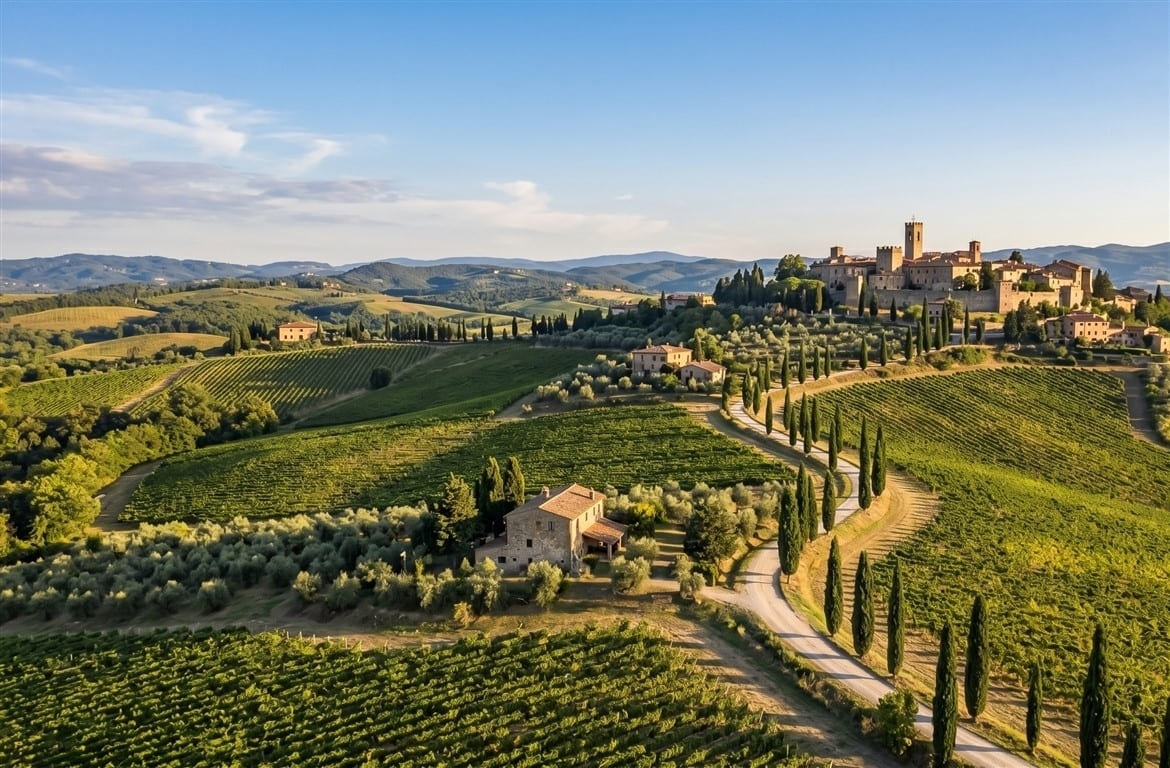
Rolling Vineyards, Verdant Olive Groves, and Ancient Medieval Villages
Chianti really deserves its own shout-out. It’s simply one of the easiest places to fully grasp why people absolutely love renting Vespas in Italy. That main road between Florence and Siena, with all its delightful offshoots towards Greve, Panzano, Radda, Castellina, and Gaiole, hands you a classic Italian landscape: vineyards stretching for miles, sturdy stone houses, and those iconic cypress-lined lanes. All without needing some epic, long expedition.
A quick note: wine tasting and scooters demand serious discipline. Taste the wine, don’t *drink* it, if you’re planning to ride afterwards. Even better, just book a tour where all the riding and food stops are managed by someone with actual sense. Italy has incredibly strict blood alcohol limits, and trust me, getting pulled over is *not* the kind of travel anecdote you want to bring home.
Vespa Tours vs. Going Solo: Your Choice
Guided Vespa Tours
A guided Vespa tour is perfect for travelers who want all the thrilling sensations without having to do any of the actual thinking. The route’s already mapped out. The timing is set. The operator knows exactly which roads are breathtakingly scenic and which ones are a total mess because some bridge repair started three months ago and just… stopped. Many tours bundle in a thorough briefing, a helmet, fuel, lunch, maybe a winery visit, or even a support vehicle.
The trade-off? Your freedom. You’ll stop only when the group stops. You’ll ride at the pace of the slowest person, which, let’s be honest, might just be you. And that’s a good, humbling experience. A guided tour makes total sense in Tuscany, Chianti, the Roman outskirts, and definitely the Amalfi Coast, especially if your confidence is a bit shaky or your time is really tight.
Self-Guided Scooter Trips
Renting a scooter independently? That’s how you get the truly epic stories. You can leave at dawn, get gloriously lost, completely scrap your lunch plans, or just linger in a town because the bakery smells so good it should be illegal. You’re not tied to a guide’s little flag or their schedule. For seasoned riders, that boundless freedom *is* the whole point.
But remember, that freedom also means all the responsibility lands squarely on your shoulders. You’ll actually read the rental contract. You’ll understand their fuel policy. You’ll do your best to avoid those ZTL fines. You’ll know if your scooter is even allowed on faster roads. You’ll check the tires, brakes, mirrors, lights, and that little compartment under the seat *before* you leave. These might sound like boring things. But they’re also the things that save your trip.
Which Option Fits Your Style Best?
| Travel style | Better choice | Why it fits |
|---|---|---|
| Brand new rider or super nervous passenger | Guided tour | You get route support, a clear safety briefing, a calmer pace, and way less navigation anxiety. |
| Experienced scooter rider | Independent rental | Hello, flexible stops! Early starts, private detours, and you’re fully in charge of your day. |
| Amalfi Coast first-timer | Guided or very short rental | Seriously, that place has heavy traffic, tight bends, huge buses, scarce parking, and roads right on cliffsides. Be safe. |
| Tuscany wine-country explorer | Either is fine! | Organized routes are a breeze, but confident riders can easily plan their own relaxed loops between charming towns. |
| Solo adventurer | Totally depends on your confidence level | Tours offer company; solo rentals offer beautiful, liberating quiet. That quiet can be the real luxury. |
What You Absolutely Need Before Riding a Vespa in Italy
License and Permit Requirements
Italy requires a valid license, specifically for the type of vehicle you intend to ride. For most visitors, the nitty-gritty details hinge on engine size. A 50cc scooter falls into a different category than a 125cc Vespa, and a 300cc scooter? That’s a whole other conversation. Rental companies can often be even pickier than the bare legal minimum, usually because their insurance policies are lurking behind the counter like a grumpy accountant.
If you hold an EU or EEA license, you can generally ride using your home license, as long as it covers the scooter category. Travelers from outside the EU or EEA are almost always asked for an International Driving Permit (IDP) or an official translation, presented *alongside* their original license. The IDP isn’t a standalone replacement; it’s a companion document. Forget one, and the rental desk might just give you that classic Italian shrug. Which means “no.”
Age Restrictions and Rental Specifics
Legally, the general driving age in Italy is 18. However, scooter rental agencies might impose higher minimum ages for 125cc or larger Vespas, often linked directly to their insurance terms. A credit card deposit is pretty much standard. Some operators will outright refuse riders without recent two-wheel experience, even if all their paperwork seems perfectly in order. This might feel a bit insulting, but honestly, it’s usually just good sense.
Before you sign anything, carefully check the allowed riding area, any mileage limits, the fuel policy, the breakdown number, the theft deductible, if helmets are included, passenger rules, and whether luggage boxes are part of the deal. Ask where the registration and insurance papers are kept. And please, *please* photograph the scooter from every single angle before you roll away. Not because everyone’s trying to scam you. But because little scratches have a curious way of turning into philosophical debates when you drop the scooter off.
Insurance and Deposits Explained
Basic third-party liability is typically included as part of legal road use. However, terms regarding damage waivers, theft excess, tire damage, mirror damage, and even underbody damage can often sit outside that friendly, advertised price. Deposits are usually held as a block on your credit card. Debit cards? Not always accepted. Cash deposits *do* exist with smaller shops, but policies vary wildly by town and even by season.
Make sure you actually read the excess amount. A cheap rental with a sky-high deductible isn’t cheap at all; it’s a gamble. If your scooter will be sleeping outdoors overnight, ask about approved parking spots. In bustling cities, the risk of theft is very real. In tiny hill towns, the bigger danger might just be fumbling the stand on sloped cobblestones while trying to look effortlessly graceful.
Staying Safe While Vespa Riding in Italy
Road Conditions and Understanding Traffic Rules
Italian roads operate with a certain confident flow. It’s not chaos, not precisely. Think more like a vibrant, improvised choreography performed by people who definitely skipped rehearsal. Lanes are acknowledged, then quickly negotiated. Roundabouts absolutely demand eye contact. Local riders filter through traffic with a serene calm that tourists definitely shouldn’t try to mimic on day one.
Standard speed limits usually sit at 50 km/h in urban areas, 90 km/h on secondary extra-urban roads, 110 km/h on main extra-urban roads, and 130 km/h on motorways—unless, of course, the signs tell you otherwise. Rain, roadworks, specific local rules, and your vehicle’s class can all alter the posted limit. Smaller scooters might even be banned from motorways and some faster roads entirely. Stick to the signs, not your gut feeling.
| Safety fact | Current travel meaning | Rider response |
|---|---|---|
| Helmets are mandatory for moped and motorcycle riders. | No helmet, no ride. Your rental shop *must* give you one. | Always check the fit and strap it securely before leaving the shop. |
| Lights are required for motorcycles and mopeds on the road. | Visibility is crucial, even when the sun is blinding. | Double-check both front and rear lights during your pickup. |
| Italy unfortunately recorded 3,030 road deaths in 2024. | Road risk isn’t some made-up travel-blog drama. It’s real. | Ride defensively, and skip those late-night rides after dinner. |
| Motorcyclist deaths hit 830 in 2024. | Riders on two wheels are always more vulnerable in crashes. | Wear protective clothing. Seriously, no beachwear on fast roads! |
| Historic centers frequently use ZTL restricted zones. | Camera fines can pop up months later, routed right through your rental company. | If signs are unclear, just park outside the center. It’s safer. |
Helmet Use and Other Protective Gear
A helmet is non-negotiable. And let’s be real: a *good* helmet is always better than just a *legal* helmet. There’s a genuine difference. Make sure it’s fastened properly. Check that the visor isn’t so scratched it looks like a permanent fog. If the rental helmet smells like a high school locker room from 1998, don’t be shy; ask for a different one.
Closed shoes are a much smarter choice than sandals. Long sleeves will protect you from both sunburn and road rash. Gloves are a godsend on longer rides, and they’ll absolutely save your palms during those silly, minor falls—the kind nobody ever imagines until they happen at 8 km/h right outside a gelateria. Whether you’re on the Amalfi Coast, in Sardinia, or cruising rural Tuscany, dress like the road is tougher than your sunny optimism.
Parking, Fueling Up, and Navigating Your Way
Scooter parking is definitely easier than car parking, but it’s not some kind of magic trick. Use those designated “moto” spaces whenever they’re available. Absolutely avoid blocking doors, ramps, delivery zones, and sidewalks. In popular tourist towns, police *will* ticket scooters. Locals might park in ways that seem utterly impossible or completely illegal, or both. Do *not* take that as your permission to do the same.
Fuel stations can be self-service, and some rural pumps might close for lunch or operate unattended with card machines only. Always carry a bank card that works with a PIN. Try to keep your tank above lazy levels, especially in Sardinia and rural Puglia. Navigation apps are super handy, but sometimes they’ll route scooters onto roads that are technically allowed, but emotionally quite unpleasant. A slow, white gravel road winding through vineyards? Perfect. A steep, broken lane with loose gravel on a hairpin turn? That can instantly ruin your entire day.
The Perfect Season for a Vespa Journey in Italy
Spring and Early Summer Bliss
April, May, and early June are prime scooter months across most of Italy. The days are gloriously long, landscapes burst with green, beaches are just starting to come alive, and inland towns still feel authentically lived-in rather than just staged for tourists. Tuscany will smell of rich, wet soil and fragrant blossoms. Puglia offers warmth without that oppressive August heat. Veneto’s hills look incredibly fresh and vibrant.
A little rain is simply part of spring. So, pack a light, waterproof layer. A scooter ride through a Tuscan shower can be charming for ten minutes, but utterly miserable for forty. Roads stay slick long after the rain starts, as oil lifts from the surface. Slow down *before* the bend, not when you’re already in it.
Late Summer and Autumn Charms
September and October are truly wonderful. The heat is softer, there’s a vibrant grape harvest energy buzzing through the wine regions, and sea temperatures are still wonderfully inviting in the south. Chianti and Val d’Orcia get busy during harvest, but the roads usually regain some sanity after the school-holiday rush. Sardinia in September? That’s a true gift, especially when the wind decides to behave.
By late October, though, mountain and inland weather can shift very quickly. Daylight hours noticeably shrink. A short, sweet itinerary beats a wildly ambitious one. Always leave some wiggle room for a long, leisurely lunch and an inevitable wrong turn; those aren’t failures, they’re often the best parts.
Dodging Crowds and Intense Heat
August is simply the toughest month for scooter travel in all the famous coastal spots. Italy itself takes its holidays then, foreign visitors arrive in massive waves, and parking becomes an intensely competitive sport. Places like Amalfi, Positano, the access points for Capri, Gallipoli, Polignano a Mare, and the Costa Smeralda can feel completely overwhelmed. Rental prices might skyrocket, and some operators even slap on seasonal surcharges.
July isn’t exactly a quiet month either. Inland heat can be absolutely brutal. If you’re determined to ride during high summer, start your day early, take a long, shaded lunch break, and only ride again once the fiercest heat has broken. That classic Italian afternoon pause? It starts to make profound, bodily sense after you’ve sat at a red light in a helmet under a relentless noon sun.
Crafting Your Perfect Vespa Itinerary
Picking the Ideal Region
Choose your region based on your riding skill, not just how pretty it looks in photos. Beginners usually fare much better on Tuscany’s more organized routes, in parts of Puglia, and on Veneto’s calmer roads. More confident riders can happily tackle the Amalfi Coast, Sardinia’s coastal stretches, and those longer, winding countryside loops. City centers like Rome, Naples, Florence, and Palermo sound exhilarating in theory. In practice, they will absolutely punish any hesitation.
- For first-time Italy scooter adventurers: seriously, opt for a half-day or full-day countryside tour starting from Florence, Siena, or a Chianti base. You get all the breathtaking beauty without wrestling with heavy urban traffic for hours.
- For glorious coastal scenery: only ride the Amalfi Coast if you have genuine scooter confidence, or choose Puglia and Sardinia instead for their wider-feeling roads and fantastic beach-to-town flexibility.
- For incredible food and wine: Chianti, the Val d’Orcia, and Veneto’s Prosecco Hills offer shorter distances, loads of scenic stops, and villages where a slow lunch feels less like a choice and more like a civic duty.
How Many Days Should You Plan?
One day is plenty for a delightful taste. Three days? That starts to feel like a real journey. A full week works beautifully in Sardinia or Puglia, assuming your scooter is comfortable and your luggage stays light. Don’t, under any circumstances, plan car-style distances. A 60-mile scooter day, peppered with village stops, photo ops, heat, and lunch, can feel surprisingly full. A 150-mile day? That can feel like pure punishment, even with endless espresso.
A simple, clean three-day Chianti plan might look something like this: pick up your scooter in Florence or transfer to the countryside, loop through Greve and Panzano, then overnight near Radda; the next day, ride to Castellina and Monteriggioni, sleeping near Siena; finally, return through olive groves and smaller, charming hamlets. Simple. Absolutely gorgeous. Not overly clever.
Where to Rest Your Head Along the Way
Agriturismi are often perfect for scooter trips. They typically offer plenty of parking space, easy rural access, and dinner right on site. In towns, always ask about secure parking before you book. “Parking nearby” can mean a legal moto bay, or it could mean a vague hope two streets away. That’s a huge difference when it’s midnight and you’re hauling luggage.
For the Amalfi Coast, staying in one base and making short rides is far smarter than changing hotels every single night. In Puglia, two bases work wonderfully: one in the Valle d’Itria and another closer to the coast. For Sardinia, please don’t underestimate the island’s sheer scale. Pick a zone and truly savor it, rather than trying to draw some massive loop that looks heroic on a map but will be dull on your backside.
Food, Wine, and Truly Local Experiences
The best Vespa day always has unplanned gaps. A tiny bakery in Pienza. A spontaneous swim near Otranto. A cheese stop that changes your life in Sardinia. A minuscule bar in Asolo where the owner gently corrects your pronunciation, then gives you infinitely better directions than your phone ever could. These aren’t just accessories to the ride; they *are* the ride.
Keep your meals light before tackling any technical roads. Absolutely skip alcohol until your scooter is safely parked for the night. Book tastings where the transport is already sorted, or where spitting is a completely normal practice and not considered an insult to human civilization. Italy, trust me, will still be utterly delicious even when you’re completely sober.
Vespa Trip Costs in Italy: A Quick Overview
Rental Prices: What to Expect
Looking at 2026, online booking platforms and local shops are showing scooter and Vespa rentals starting from roughly the mid-€40s per day in some parts of the Amalfi area. However, most 125cc Vespa-style rentals in popular destinations often land higher, frequently sitting around €60 to €90 per day *before* any extras. Listings for Rome and Sorrento often fall within that range. Just a heads-up: August can often mean a seasonal surcharge at coastal rental shops.
Prices fluctuate based on engine size, how long you’re renting for, the model itself, the insurance package you choose, your pickup location, and, of course, the season. A 50cc scooter will be cheaper but noticeably slower. A 125cc Vespa is generally the sweet spot for many tourists doing shorter routes. Larger scooters cost more, but they handle longer distances and hills with far less drama.
Tour Packages: Group Fun
Guided Tuscany Vespa tours from Florence typically range around €100 to €150 for drivers, with passengers usually costing less. Some tours might include lunch or tastings; others keep food as a separate expense. Expect prices to climb for private tours, vintage models, hotel pickup, and smaller group formats. Multi-day Vespa trips cost significantly more, as accommodation, detailed route planning, support vehicles, and sometimes meals are all factored into the bill.
| Expense | Typical 2026 range | Notes |
|---|---|---|
| Basic scooter rental | Around €45–€70 daily | Usually a 50cc or standard scooter; depends heavily on the destination. |
| 125cc Vespa rental | About €60–€90 daily | Very popular choice for Rome, Sorrento, Amalfi, and Tuscan towns. |
| Guided Tuscany ride | Around €100–€150 for the driver | Food, fuel, or transfers might be bundled in by certain operators. |
| Passenger on tour | Often less than the driver’s price | A great option for couples where only one person feels confident riding. |
| Deposit or card hold | Amount set by the rental company | Always check the excess, theft terms, and their full damage policy. |
| Fuel | Low for shorter routes | Returning the tank with the right fuel level often matters more than the raw fuel cost itself. |
Those Sneaky Extra Costs to Budget For
Make sure you budget for parking fees, a phone holder, a rain poncho (seriously, get one), any extra insurance you opt for, luggage storage, hotel delivery if needed, those infamous ZTL fines if you accidentally mess up, and a second helmet if it’s not already included. Some rentals boast unlimited mileage; others don’t. A “bargain” can quickly lose its charm after all the add-ons start piling up.
Food costs really deserve their own little envelope. A scooter day practically *invites* stops: a quick espresso, some bottled water, a slice of focaccia, an irresistible gelato, then a trattoria lunch that starts out innocent and ends with you genuinely wondering if pecorino cheese has healing powers. Always carry some cash for smaller towns. Cards are common, but that tiny bar with the absolute best view might just have a machine that’s “not working today,” delivered with a dramatic sigh.
Your Burning Questions About Vespas in Italy, Answered
Is Riding a Vespa in Italy Truly Easy?
Mechanically, a Vespa is pretty straightforward for most people: twist-and-go throttle, automatic transmission on modern models, and light handling at lower speeds. Italy, though, that’s the trickier part. The local traffic style, the hills, the cobblestones, hairpin turns, parked cars everywhere
0 Comment